Carer's assessment: your right to support if you look after someone
In short
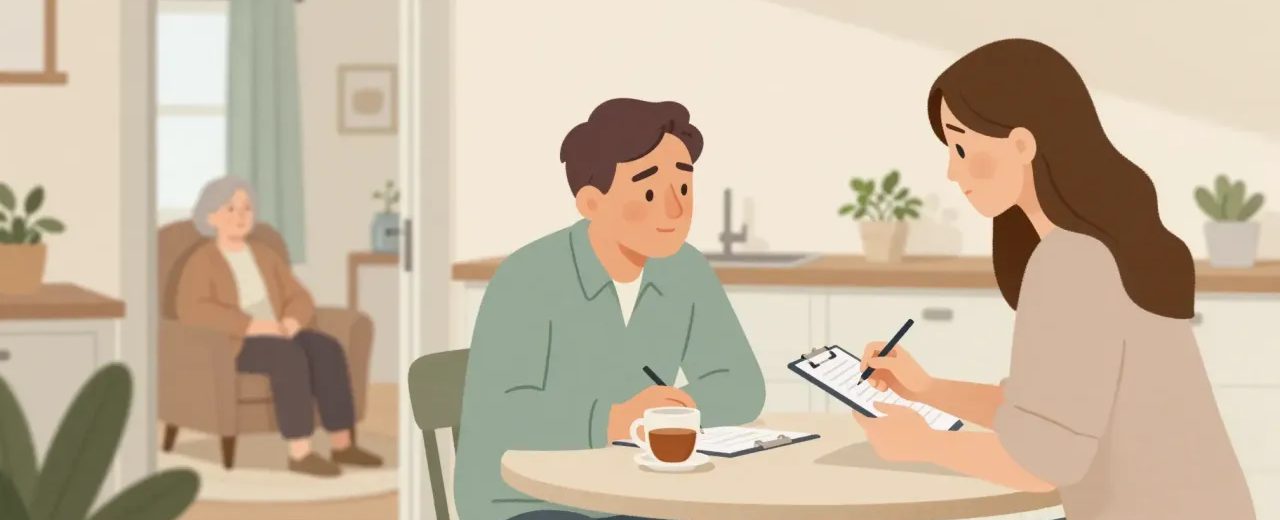
- If you look after an adult who could not manage without your help, you can ask the council for a carer's assessment. It is free. Your money, and how much you do, do not stop you getting one.
- The assessment is about you: your health, your sleep, your work, your time to yourself, and whether you can keep caring. It is not a test of how good a carer you are.
- If you are eligible, the council must help. That could be a break, help at home, or a carer's direct payment. If not, it must still give you advice. If you are unhappy, you can complain and then go to the Ombudsman.
Urgent? If someone is in danger or very unwell, call 999. For urgent medical help, call NHS 111 or contact your GP. This page cannot give medical or personal advice. If you feel you cannot carry on caring today, tell the council that clearly when you call.
Lots of people look after a husband, wife, parent, child or friend without thinking of themselves as a "carer". If you help someone with things they cannot do on their own, the law sees you as a carer, and you have rights of your own. This page explains the carer's assessment in England: who can get one, what it looks at, what help might follow, and what to do if things go wrong.
Who counts as a carer
For this assessment, a carer is an adult who looks after, or is going to look after, another adult (Care Act 2014, section 10(3)). Care can be practical help, like cooking, washing or getting about. It can also be emotional support, like keeping someone calm or safe (section 10(11)).
- You do not have to live with the person.
- You do not have to be related to them.
- You can work, study, or get Carer's Allowance and still be a carer.
- People who care as a paid job, or as volunteers for an organisation, do not usually count (section 10(9) and (10)).
Under 18, or looking after a disabled child? There are separate assessments for you. See young carers and parent carers below.
Your right to an assessment
If it looks as if you may need support, now or in the future, the council must offer you a carer's assessment (Care Act 2014, section 10(1)). This applies whatever level of need you have, and whatever money you or the person you look after have (section 10(4)). The official guidance says councils must assess where a carer may have "any level of needs" (Care and Support Statutory Guidance, 6.16).
- It is separate from the other person's assessment. You can have one even if the person you care for has not been assessed, or has said no to help. You can ask for both to be done together, but only if you both agree (Care Act 2014, section 12(5); Statutory Guidance, 6.74).
- You can talk privately. The guidance says that, where appropriate, your views should be asked for "in a separate conversation" from the other person's assessment (Statutory Guidance, 6.18). This can help if it is hard to speak openly in front of them.
- Said no before? You can ask again. If you turned down an assessment, the council must do one if you ask later (Care Act 2014, section 11(6)).
- Which council? Contact the council for the area where the person you look after lives, even if you live somewhere else (Statutory Guidance, 19.6; Citizens Advice: carers help and support).
What the assessment looks at
By law, the assessment must look at (Care Act 2014, section 10(5) and (6)):
- whether you are able to care, and likely to stay able
- whether you are willing to care, and likely to stay willing
- how caring affects your wellbeing, including your health, feelings, relationships and money
- what you want to achieve in your own day-to-day life
- whether support could help you with those things
- whether you work or want to work, and whether you want to study, train or do things you enjoy
It must also look at the future, not just today, and whether your caring role can carry on (Statutory Guidance, 6.18 and 6.19). The council must involve you, and anyone you ask it to involve (section 10(7)).
How it is done
- It is often a face-to-face meeting, but it can be by phone or online. The NHS says it usually takes at least an hour (NHS: carer's assessments; Statutory Guidance, 6.28).
- The council should tell you roughly how long the process will take, and keep you updated (6.29).
- It should give you the questions in advance, in a format you can use, so you can prepare (6.38).
- If you are able and willing, it must offer you a supported self-assessment, where you fill in the form yourself with the council's help (6.44).
- If you would find it very hard to take part, and nobody suitable can help you, the council must arrange an independent advocate (Care Act 2014, section 67).
- Afterwards, you must get a written record of your assessment (Care Act 2014, section 12(4)).
Are you eligible for support?
After the assessment, the council decides if you have "eligible needs". There is a national test with 3 parts. You are eligible if all 3 are true (Care and Support (Eligibility Criteria) Regulations 2015, regulation 3):
- Your needs come from giving necessary care to an adult.
- Because of this, your physical or mental health is getting worse or is at risk of getting worse, or you cannot do at least one of the things in the list below.
- As a result, there is, or is likely to be, a significant effect on your wellbeing.
The list of things is:
- looking after a child you are responsible for
- caring for anyone else you look after
- keeping your home in a fit state to live in
- eating properly and keeping up with meals
- keeping up family and other important relationships
- work, training, education or volunteering
- using local services and facilities
- hobbies and things you do to relax
"Cannot do" also counts if you can only do it with significant pain, distress or anxiety, or if doing it puts your health or safety, or someone else's, at risk (regulation 3(3)). If your caring role goes up and down, the council should look at it over a fair period of time (regulation 3(4)).
You can be eligible even if the person you look after is not (Statutory Guidance, 6.118). The council must give you its decision, and the reasons, in writing (Care Act 2014, section 13(2)). For more on how the test works, see our guide to eligible needs.
What support might follow
If you have eligible needs, the council must meet them, as long as the person you look after lives in its area (Care Act 2014, section 20). You should get a support plan and a carer's personal budget. The budget must be enough to meet your needs and help with the things you want to achieve (Statutory Guidance, 11.40).
Help might include:
- A break. Someone else looks after the person for a while, at home or in a short care home stay. This is called replacement care or respite (NHS: carer's assessments; Carers UK: taking a break).
- Things for your own wellbeing. The guidance gives examples like relaxation classes, stress management training, gym or leisure centre membership, adult learning, work skills, and hobbies (Statutory Guidance, 11.41).
- Practical help. The NHS lists things like help with taxi fares, gardening or housework, training on lifting safely, support groups and benefits advice (NHS: carer's assessments).
- More help for the person you look after, so that you have less to do. If the support goes to them, they must agree to it (section 20(7)).
Carer's direct payments
You can ask for your support as a direct payment. This is money paid to you so you can choose and arrange the help yourself. It does not count as income, so it does not affect your benefits (Carers UK: direct payments). Many councils pay carers a one-off sum, often once a year, for things like a short break, a hobby, a course or equipment that makes caring easier.
There is no single national amount. Some councils set their own upper limit. For example, Torbay Council offers up to £200 for basic carer support, with more possible for greater needs, and Warrington Council offers a one-off payment of up to £500. Whatever the amount, your carer's personal budget must be enough to meet your eligible needs (Statutory Guidance, 11.40). Ask your council what it offers, and how it works out the amount.
The money must be spent on what is agreed in your support plan, and you will usually need to keep receipts. You can read more in our guide to direct payments and personal budgets.
If you are not eligible
The council must still give you written information and advice about what could help, such as local carers' groups, and how to stop things getting worse (Care Act 2014, section 13(5); Statutory Guidance, 6.133). If things change, ask for a new assessment.
Will I have to pay?
- The assessment is free (NHS: carer's assessments).
- Support for you. Councils are allowed to charge carers for support given directly to them, but they do not have to. The guidance says: "Local authorities are not required to charge a carer for support and indeed in many cases it would be a false economy to do so" (Statutory Guidance, 8.49 and 8.50). If your council does charge, it must follow the charging rules, which usually means a financial assessment (8.53). Ask your council what its policy is.
- Care for the person you look after. A council must never charge you, the carer, for care given directly to the person you look after (8.49). If replacement care is charged for, it is the person receiving it who may pay, after their own financial assessment (Statutory Guidance, 11.45).
Young carers and parent carers
- Young carers (under 18). A child who looks after someone can ask for a young carer's needs assessment from the council. A parent can ask too (Children Act 1989, section 17ZA). When councils assess an adult, they must also think about any child who is helping to care, and whether what the child is doing is too much (Statutory Guidance, 6.68 to 6.72). See NHS: being a young carer, your rights, Carers UK: support for young carers and Carers Trust.
- Parent carers. If you look after a disabled child you are responsible for, you can ask for a parent carer's needs assessment from children's services (Children Act 1989, section 17ZD). The charity Contact has a free helpline for families with disabled children on 0808 808 3555 (NHS: carer's assessments).
How to ask
- Find the right council. It is the council where the person you look after lives. Use GOV.UK: find your local council or our find your council tool.
- Contact adult social care. Phone, email or use the online form. Say: "I am a carer and I would like a carer's assessment, please." Many councils let you ask online (NHS: carer's assessments).
- Put it in writing if you can. This gives you a record of the date. You can use our free letter to ask for a carer's assessment.
- Write down who you spoke to and when. Keep a note of any reference number.
What to say on the day
Carers UK advises being honest and realistic. If you put on a brave face, you could miss out on support (Carers UK: carer's assessment). It can help to jot down a few notes first:
- what you do in a normal day and night, and how many hours it takes
- a bad day: what happens and how it leaves you feeling
- your own health, sleep and stress
- what you have had to give up, such as work, friends or hobbies
- what would make the biggest difference to you
- whether you are willing and able to carry on as you are
You can have someone with you, such as a friend or relative. Have the person's NHS number and GP details to hand, in case you are asked (NHS: carer's assessments).
If you are refused or unhappy
- Ask for reasons in writing. If the council says you do not need an assessment, or are not eligible, ask it to explain why in writing, and quote section 10 of the Care Act 2014.
- Check your written record. If something important is missing or wrong, tell the council and ask for it to be corrected.
- Make a complaint. Use the council's complaints process. You can use our free complaint letter.
- Go to the Ombudsman. The Local Government and Social Care Ombudsman is free and independent. You usually need to finish the council's process first. You can also go to them if the council has not replied in a reasonable time, which they say is usually up to 16 weeks.
Examples
These are made-up examples to show how things can work. They are not real people. Every case is different.
In Scotland, Wales and Northern Ireland the rules are different. Contact your local council, or your Health and Social Care Trust in Northern Ireland. Carers UK has information for each nation.
Free help
- Your council. Ask adult social care for a carer's assessment, and ask about local carers' services. Use our find your council tool if you need the details.
- Carers UK: carer's assessment. The free Carers UK Helpline is 0808 808 7777, Monday to Friday, 9am to 6pm (Carers UK: helpline).
- Carers Trust, for local carers' centres and support for young carers
- Citizens Advice: carers help and support
- NHS: carer's assessments. The NHS also lists the free Age UK helpline (0800 678 1602) and Independent Age helpline (0800 319 6789).
- GOV.UK: Carer's Allowance, if you care for 35 hours a week or more
- The official rules: Care Act 2014, section 10 and Statutory Guidance chapter 6
Information only. This page explains official guidance in plain English. It is not legal or medical advice. Rules can change. For advice about your own case, contact Citizens Advice or another free adviser.
Where this applies: England. Scotland, Wales and Northern Ireland have different rules.
Written by Social Care Made Easy. Last checked: 31 October 2026.